

1,113 data breaches were reported to the Australian Information Commissioner (OAIC) in the last year alone. This represents a 25% increase in annual notifications and the highest total since mandatory reporting began. The financial services sector remains one of the top targets for these malicious cyber-attacks.
The core problem for Australia in 2026 is that the standard personal finance advice has pushed users toward automation. Most finance apps now insist on bank syncing as a default. This requires you to share your bank credentials with a third-party app.
While convenient, this practice creates an unnecessary risk. You are essentially handing over the keys to your financial vault to a middleman. If that aggregator suffers a breach, your savings account and credit card details are exposed.
Furthermore, the subscription business model of 2026 has made money management invisible. Automated trackers often categorize these expenses weeks after they occur. This delay reinforces passive spending rather than active control.
This article posits that the safest way to manage your data is to eliminate the bridge between your bank and your tracker. By choosing an expense tracker without bank linking, you protect your privacy and force a cognitive engagement with your spending.
2. The Risks of Linking Your Bank Account to Third-Party Apps
Sharing your bank credentials with a third-party app is the single greatest security risk in modern personal finance. While bank syncing is marketed as a convenience, it requires you to bypass the fundamental security protocols of your financial institution.
Most automated trackers use a process called screen scraping. This involves giving an app your bank login details so it can impersonate you and extract data. This practice is so inherently unsafe that the Australian government has initiated a reset of the Consumer Data Right (CDR). Regulators are now moving toward a full ban on screen scraping by mid-2026.
The Security Vulnerability
When you link to your bank account via a middleman, you create a permanent target for hackers.
- Credential Exposure: If the tracking app or its data aggregator is breached, your bank login details are compromised.
- Loss of Protection: Many Australian banks state that sharing your password with a third party may void your fraud protection guarantees. You might not be covered if unauthorized transactions occur.
- Scope Overreach: Aggregators often collect more information than is necessary. They may scrape your full transaction history, loan details, and personal identity data.
The Reliability Problem
Bank connections are notoriously fragile. Changes in bank security settings often lead to broken feeds. This forces you to constantly re-authenticate and fix sync errors. This technical friction often results in missing data. A tracker with missing data is useless for tax preparation or professional accounting.
By avoiding bank linking, you eliminate these vulnerabilities. You maintain a local and secure record of your income and expenses that no aggregator can access or leak. This is the only way to ensure your financial data remains entirely under your control.
3. Why Australians are Switching to Manual Expense Tracking
The trend toward manual entry in 2026 is driven by a desire for financial awareness. Automated systems have created an awareness gap. When a budget app handles everything in the background you lose touch with the value of your money.
Friction as a Financial Tool
In behavioral economics friction is often viewed as a negative. However in personal finance friction is a powerful defense against overspending. When you use a manual expense tracker app you must add transactions yourself. This small act of data entry creates a psychological speed bump.
- Active Acknowledgement: You are forced to see the exact cost of a purchase at the moment of impact.
- Impulse Control: Knowing you have to log an expense makes you think twice before tapping your iPhone for an unnecessary item.
- Immediate Categorization: You track spending with context that a bank cannot provide.
The Return of Envelope Budgeting
Many Australians are returning to the envelope budgeting system. This method involves allocating funds to specific “buckets” for different costs. By using an app to track these envelopes manually you gain a level of discipline that automation cannot replicate.
You see your remaining balance in real time as you track your spending. This prevents the common mistake of spending your rent money because your transaction account looked full. Manual tracking transforms you from a passive observer into an active manager of your finance goals.
4. Best Expense Tracker Without Bank Linking: Top 3 Methods
There is no single best expense tracker that fits every Australian. The ideal expense tracking method depends on your technical comfort and your need for data portability. These are the three most effective ways to track expenses without linking bank accounts in 2026.
Method 1: Privacy-Focused Apps (The Expense6 Model)
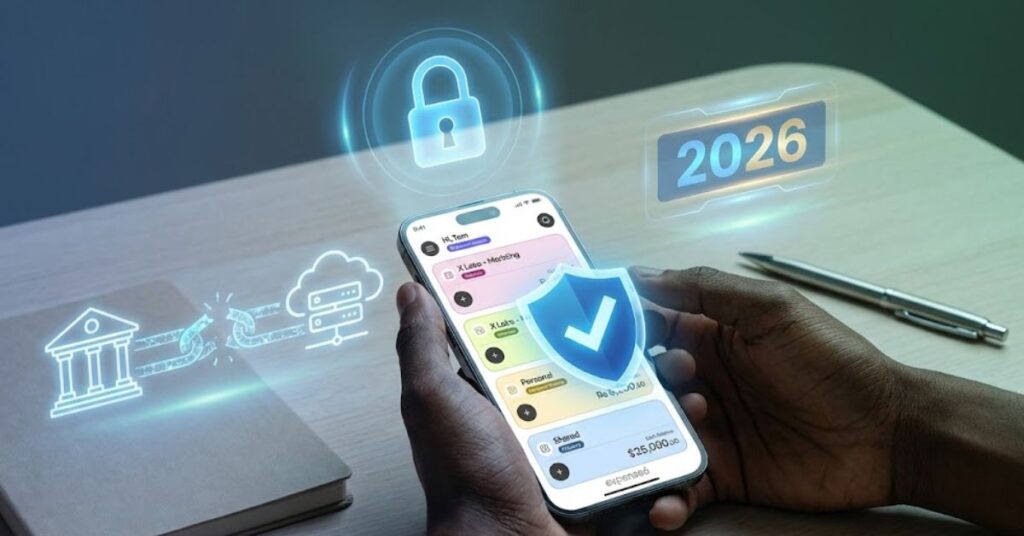
A dedicated mobile app like Expense6 is the modern standard for privacy and security. This tool is a budget app that does not require bank credentials to function. Instead of one large pool of data it uses the Workzone system.
- Contextual Tracking: You can create unlimited envelopes and accounts through separate Workzones. This allows you to manage business and personal finances in one place without mixing them.
- Privacy: Since there is no bank connection required your data stays on your device or in your private cloud. This eliminates the risk of being targeted by the subscription business model of data brokers.
- Full Functionality: You get high end features including receipt scanning and invoice generation. This is the best expense tracker for those who want professional tools without the surveillance.
Method 2: The Spreadsheet Hybrid (Excel and CSV)
This is a powerful way to track finances for those who enjoy data analysis. You use Microsoft Excel or Google Sheets as your master budget tracker.
Most Australian banks and credit unions allow you to export your transaction history. You download a comma-separated values (CSV) file or a Quicken Interchange Format (QIF) file from your online banking portal. You then import this data into your spreadsheet.
- Customization: You can build a spreadsheet that helps you visualize net income and spending patterns with custom charts.
- Control: You choose how to categorize your expenses. You are not limited by the rigid categories of a third-party app.
- Zero Cost: If you already own a computer this is a free budget method.
Method 3: The Analog Approach (Pen and Paper)
The most traditional way to track expenses involves a notebook and a pen. While it lacks automation it offers the highest level of privacy.
- No Tech Risk: There is no chance of a data breach or a server outage.
- Tactile Awareness: Writing down your daily expenses by hand makes the act of spending feel real.
- One of the Simplest Ways: This is a basic way to keep track of your expenses if you have a low volume of transactions.
However this method is easy to lose. It also makes tax time difficult for your accountant. It is best for simple households rather than complex business expenses.
5. How to Manage a Budget Without Sharing Bank Connections
Transitioning to a budget tracker that does not rely on automation is a straightforward process. You do not need to wait for a bank sync to see your financial status. You can manage your monthly budgets and money goals with high precision by following a simple daily workflow.
Step 1: Manually Add Transactions at the Point of Purchase
The most effective way to maintain awareness is to manually add transactions the moment you spend money. Whether you use an iPhone or an Android device, the habit takes less than ten seconds.
- Open your app immediately after a purchase.
- Enter the amount and a brief description.
- Select a category to ensure your data stays organized.
Step 2: Snap a Digital Receipt
A receipt is the only legal proof of an expense for tax purposes. Do not let paper slips clutter your wallet.
- Use the camera feature within the app to take a photo.
- Attach the image directly to the transaction.
- Discard the paper copy once the digital version is securely stored.
Step 3: Track Income and Monitor Goals
You must also track income to get a complete picture of your cash flow. This includes your primary salary and any side hustle payments.
- Log every payment as it enters your account.
- Compare your total spending against your pre-set limits.
- Adjust your behavior if you see you are approaching your limit for the month.
By taking these steps you ensure your records are always up to date. You no longer have to worry about missing transactions or bank feed errors. You are the sole owner of your financial story.
6. Maximizing ATO Deductions Without the “Data Soup”
The Australian Taxation Office (ATO) requires clear evidence for every deduction you claim. When you use automated bank feeds you often end up with a “data soup.” This is a cluttered list of transactions where business and personal costs are mixed together. This lack of clarity makes record-keeping difficult and increases the chance of an audit.
By using an expense tracker without bank linking you create a clean trail of income and expenses. You categorize each item at the source. This ensures that your tax records are organized by context rather than just by the date of the bank transaction.
Key Actions for Australians
- Export Professional Reports: Generate a PDF or CSV report that is structured for your accountant. This saves them time and reduces your billable hours.
- Separate Contexts: Use Workzones to isolate your ABN business from your personal life. This provides the “nexus” between earning income and spending money that the ATO looks for.
- Audit-Proof Your Files: Digital copies of receipts are legal records. Storing them within your app ensures you never lose a deduction due to faded thermal paper.
This proactive approach makes tax time a simple administrative task instead of a high-stress event. You maintain a professional financial data set that stands up to scrutiny without ever exposing your bank login.
Conclusion
85% of cybersecurity experts recommend limiting the number of third-party applications that have direct access to your primary bank accounts. In an era of increasing data vulnerability, the safest way to manage your financial data is to keep it disconnected from the cloud.
Choosing an expense tracker without bank linking is more than a security measure. It is a commitment to financial mindfulness. By avoiding bank syncing, you regain the discipline required to take control of your money. You stop being a passive observer and start being an active manager of your personal finance goals.
Expense6 provides the perfect framework for this transition. Through the use of isolated Workzones, you can manage your business and personal life with total privacy and security. You get professional-grade tools like receipt scanning and invoice generation without ever compromising your bank login details.
Privacy is the ultimate financial asset in 2026.
Take the first step toward true financial sovereignty. Expense6 is free to download and ready to help you organize your life without the risks of automation. Start your first Workzone today and see the difference that active tracking makes to your bottom line.