

90% of rental property tax returns in Australia contain at least one error. Data from the Australian Taxation Office (ATO) confirms that most investors fail to report income and expense items correctly. This leads to missed tax deductions or costly audits that erode your return on investment.
In the 2026 property market, precision is no longer optional. Real estate investment has become a game of margins. High interest rates and fluctuating valuation metrics mean that every dollar must be accounted for. Many property investors still rely on a “shoebox” method or a basic spreadsheet. These methods are prone to failure because they lack the structure required for modern compliance.
Managing rental properties requires a shift from passive recording to active financial management. You must track rental property costs as they occur to ensure your tax return is accurate. A dedicated rental property expense tracker provides the framework to separate your investment property from your personal life.
The goal of this guide is to move you away from disorganized bookkeeping. You will learn how to maintain a professional balance sheet and income statement for your assets. By adopting a strategic approach, you can protect your equity and ensure your portfolio remains profitable after tax.
2. Why Manual Tracking Beats Bank Feeds for Property Investors
Automated bank feeds are often marketed as a time saving tool for investors. However they carry significant risks for rental property accounting. The Australian Taxation Office (ATO) has increased its data matching capabilities in 2026. Automated systems often misclassify expenditure.
A common error is the failure to distinguish between a repair and an improvement. A repair is a like for like fix that restores the property to its original state. This is an immediate deduction. An improvement adds value or extends the functional life of the asset. This must be claimed as depreciation over several years.
Automation cannot see the physical nature of the work. If you fix a leaking tap it might look identical to a full kitchen fixture upgrade in a raw bank statement. Manual entry forces a mindfulness gap where you categorize the expense correctly at the point of purchase. This ensures you do not trigger an audit by overclaiming immediate costs.
Privacy is another major factor for real estate investors. Connecting your bank account to third party aggregators creates a permanent security risk. Your intimate financial data becomes a product for insurers and lenders to analyze your spending habits.
Expense6 prioritizes privacy by using a manual entry model. You keep your bank credentials secure while ensuring every rental property expense is categorized with precision. This proactive record keeping approach is the only way to guarantee you are tax time ready without compromising your digital security.
3. The “Workzone” Strategy for Property Portfolios
Concept: Contextual Separation Over Account Segregation
Managing a property portfolio in 2026 requires a shift in how you view financial boundaries. Traditional accounting software often forces you to track by bank account. However an Australian investor might use one offset account to pay for expenses across three different rental properties. This creates a “data soup” where it becomes nearly impossible to see the true return on investment of a specific asset.
The “Workzone” strategy solves this by separating finances based on the property address rather than the bank account. It acknowledges that your portfolio is a collection of individual businesses. Each house, apartment or commercial unit deserves its own “set of books” to ensure you are not cross-contaminating your data.
Expense6 Context: Dedicated Zones for Every Asset
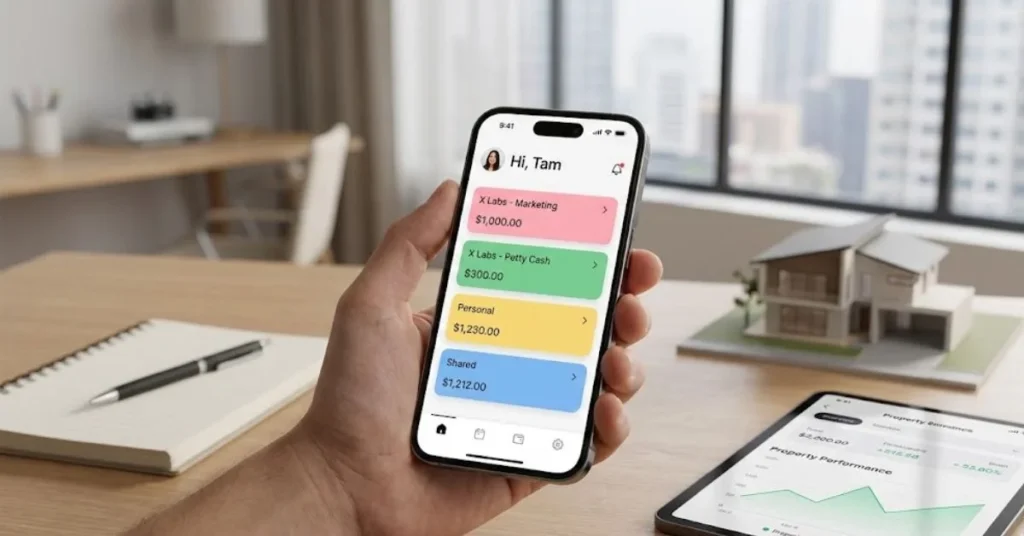
Expense6 is built on this principle of unlimited, isolated Workzones. Instead of a single list of transactions you create a dedicated Workzone for each residential rental property.
Implementation: Managing Your Portfolio Like a Pro
For property investors the implementation is straightforward and powerful.
- Zone Isolation: You create a Workzone named “12 Smith St, Richmond”. Inside this zone you only log rental income and rental property expenses specifically related to that site.
- Income Sources: You track rent payments as income. Because you enter these manually you can immediately flag if a tenant is behind. You do not have to wait for a bank statement to sync.
- Contextual Sourcing: If you use your personal credit card to pay for a repair at the Smith St property you log it in the Smith St Workzone. You simply select your personal account as the “source.” This keeps the expense linked to the property for tax time while accurately reflecting where the money actually came from.
ROI and Financial Clarity
By using track rental property expenses in separate Workzones you get a real-time view of your cash flow per property. Most landlords do not know their actual net income until their accountant finishes their tax return months after the financial year ends.
With Workzones you can see your financial position instantly. You can compare the roi of a dual-occupancy dwelling against a single-title house. This granular visibility allows you to make informed decisions about when to sell, when to renovate or when to increase rent to cover rising interest costs.
The Workzone strategy transforms you from a passive landlord into a strategic investor. It ensures that your portfolio is organized, compliant and optimized for maximum tax savings.
4. Essential Categories for Your Rental Property Accounting
Interest on loans accounts for over 60 percent of total deductible rental expenses for the average Australian investor. This makes it the most significant category to track. However the Australian Taxation Office (ATO) requires a granular breakdown of all property income and expenses to accept your claims.
Using a rental property expense tracker allows you to bucket your expenditure into the following essential categories.
- Interest on Loans: You can claim the interest charged on the loan used to purchase your investment property. You cannot claim the principal repayments.
- Property Management Fees: This includes commissions paid to your property manager and fees for sourcing new tenants.
- Repairs and Maintenance: These are costs to fix wear and tear. Examples include fixing a broken fence or servicing an air conditioner.
- Body Corporate Fees: If your property is a strata title you must track these quarterly levies. Note that special levies for capital expenses like a new roof must be treated differently.
- Council Rates and Land Tax: These are standard holding costs. They are fully deductible for the period the property was rented or available for rent.
- Insurance: This covers building insurance and landlord insurance. These policies protect against tenant default or malicious damage.
It is easy to lose track of small costs like pest control or gardening. These minor items often add up to thousands of dollars in tax savings over a financial year. Expense6 allows you to categorize your expenses instantly within your Workzone. This ensures that every rental property expense is assigned to the correct bucket before the receipt fades.
5. Maximising Deductions with a Depreciation Schedule
Depreciation is one of the most powerful yet misunderstood tax deductions available to Australian property investors. It allows you to claim the wear and tear of a residential rental property and its fittings as a non cash expense. Unlike a repair that you pay for today depreciation represents the gradual decline in valuation of the asset over time.
To maximise your return you must have a professionally prepared depreciation schedule. This document outlines exactly how much you can claim for the building structure and plant and equipment items each year. Capital expenses like a new roof or a hot water system cannot be claimed in full immediately. They must be spread across their useful life as determined by the Australian Taxation Office (ATO).
A rental property expense tracker helps you stay on top of these claims during tax preparation. When a deduction is claimed for a new oven or carpet you can log the purchase date and cost directly in your Workzone. This creates a permanent record that matches your official schedule.
Failing to track these details leads to significant financial leakage. Many investors forget to claim for items purchased during the financial year. By using Expense6 to record these capital expenses as they occur you ensure your accountant has everything they need. This proactive approach ensures you do not leave thousands of dollars on the table at tax time.
6. Staying ATO-Ready: Receipts and Record-Keeping
The Australian Taxation Office (ATO) mandates that you keep records of all rental income and expenses for five years from the date you lodge your tax return. Paper receipts are no longer a viable long-term solution for investors. Most thermal paper receipts fade and become unreadable within months. This creates a significant risk if you are selected for an audit.
A digital record-keeping system is essential for an accurate rental property history. Instead of keeping a shoebox full of receipts you should transition to a secure document storage system. This ensures your evidence is protected from physical damage or loss. It also makes your files searchable and organized.
Expense6 simplifies this by allowing you to attach a receipt directly to every transaction. You snap a photo of the invoice or bill at the point of purchase. The app stores the digital copy within the relevant Workzone. This creates a direct link between your financial data and your supporting evidence. If the ATO requests proof for a specific deduction you can retrieve the image instantly. This level of organization turns a stressful audit into a simple administrative check.
7. Calculating Your ROI and Cash Flow
A rental property is a business. You must treat it as one by measuring its performance regularly. Many investors look at their bank balance to gauge success. This is a mistake. Your bank balance does not account for upcoming liability items or taxation requirements.
You need to calculate your return on investment (roi) to understand the efficiency of your capital.
- Gross Rental Yield: This is your annual rental income divided by the property value. It is a surface level metric.
- Net ROI: This is your net income after all expense items are deducted. This is the true measure of your financial position.
- Cash Flow: This is the money left over after all payment obligations are met. Positive cash flow means the property sustains itself. Negative cash flow may offer negative gearing benefits but requires outside revenue to maintain.
Expense6 provides real-time summaries within each Workzone. You can see your after-tax position without waiting for an accountant. This allows you to identify which assets in your property portfolio are underperforming. You can then make data-driven decisions about your real estate investment strategy.
Conclusion
Managing an investment property is a significant financial responsibility. Disorganization is the biggest threat to your wealth. If you lose a receipt or miss a deduction you are essentially giving away your profit.
An accurate rental property history is your best defense against the Australian Taxation Office. It is also your best tool for growth. By using a dedicated tracker you stay on top of your finances year round.
Stop letting your rental property accounting overwhelm you. Download Expense6 and create your first property Workzone today. Experience the clarity of professional record keeping and maximize your tax savings.